Stanford Commencement Address (2005)
Stanford · 15 min · Stanford University Commencement
Open in YouTubeThe core argument
You cannot connect the dots looking forward, only backward, so the present is the only place you get to decide. Losing what you loved — a job, a company, a category — is not a detour; it is often the entrance to the next act. And mortality is the best focus tool ever invented.
Three stories: connecting the dots, love and loss, and death. Jobs uses his own arc — dropping out, getting fired from Apple, and facing cancer — to argue that trusting the work you love is the only strategy that compounds.
Annotated timestamps
3–5 min core argumentsSkip the full lecture — jump straight to the passages that matter. Each clip links to YouTube at the exact moment.
- 01Connecting the dots backward▶ 00:30
The calligraphy class that seemed useless in 1972 gave the Mac its typography in 1984. Trust that the work you choose will eventually connect — you cannot verify it in advance.
- 02Getting fired from Apple▶ 05:20
The public failure was the pressure that let Jobs start NeXT and Pixar. 'The heaviness of being successful was replaced by the lightness of being a beginner again.'
- 03Remembering you will die▶ 10:10
Death is the ultimate filter: ask yourself every morning if today were your last, would you still do this? 'Your time is limited, so don't waste it living someone else's life.'
Founder cross-references
opposing & complementary takesGrove's 'only the paranoid survive' and Jobs's 'losing everything is the setup' both treat crisis as the operating condition of a healthy company, not its exception.
Bezos's Day 1 posture is the institutional version of Jobs's mortality focus — a mechanism to keep a company behaving like a beginner long after it became a giant.
Ideas in this lecture
Companion reads
All books →Creative Selection
Ken Kocienda
Creative Selection
★★★★½Ken Kocienda · 2018
Inside Apple's design process during the original iPhone.
Steve Jobs
Walter Isaacson
Steve Jobs
★★★★★Walter Isaacson · 2011
The authorized biography of the man who made design a strategic weapon.
Walt Disney: The Triumph of the American Imagination
Neal Gabler
Walt Disney: The Triumph of the American Imagination
★★★★½Neal Gabler · 2006
The definitive biography of the man who turned imagination into an industry.
Keep exploring
 10 min
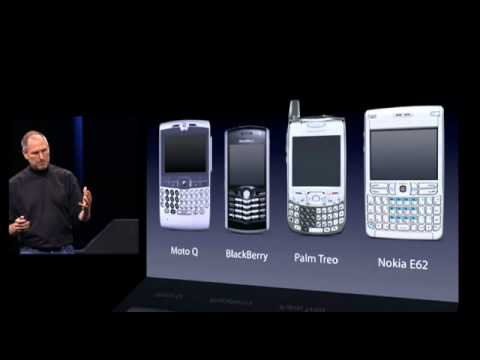
Introducing the iPhone (2007)
The segment where Jobs re-invented the phone market by refusing to compete with phones. The reveal frames every existing device as a compromise — then shows one product that removes the keyboard, the stylus, and the compromise.
 1h 15m
Brian Chesky: Designing a 10-star Experience
Chesky's signature framework for treating a company as a designed experience: from the 1-star 'worst hotel' to the 10-star 'impossible' experience, and how that ladder forces teams to invent rather than optimize.
 22 min
Jony Ive: The Lessons He Learned From Steve Jobs
Ive on craft, focus, and the discipline of removing: why the most important design decision is usually the one to delete something, and how he learned to protect the integrity of an idea against the seduction of feature creep.