Western
Classics
Monumental works of epic scope, allegorical vision, and the interplay of theology, philosophy, and the human soul.
These works deal with epic scope, allegorical or visionary journeys, the human soul, sin and redemption, temptation, divine order, free will, and the interplay of Christian theology with classical and folk traditions. They are frequently discussed alongside Dante's Divine Comedy, Milton's Paradise Lost, Bunyan's Pilgrim's Progress, and Goethe's Faust.
Section I
Foundational Epics & Visionary Journeys
Heroic quests, fate, gods, and human limits—the bedrock of the Western epic tradition.
Iliad & Odyssey
Homer
The bedrock for later epics including Virgil and Milton. Heroic quests, fate, gods, and human limits.
Aeneid
Virgil
A pious hero’s journey founding Rome. Hugely influential on Dante (Virgil is his guide) and Milton.
The Divine Comedy
Dante Alighieri
The gold standard for moral cosmology and the pilgrimage through Hell, Purgatory, and Paradise.
Paradise Lost
John Milton
Cosmic rebellion, the Fall, and redemption. Read with our dedicated companion.
Open Experience →The Faerie Queene
Edmund Spenser
Vast Protestant allegory of virtue, chivalry, and Elizabethan England. Six completed books of the projected twelve.

Illustration · Gustave Doré
Satan on the Lake of Fire — Paradise Lost, Book I. Cast from Heaven, Satan lies bound on the burning lake: “how fall’n! how changed / From him who in the happy realms of light…”
“The mind is its own place, and in itself
Can make a Heav’n of Hell, a Hell of Heav’n.”
— John Milton, Paradise Lost, Book I

Illustration · Gustave Doré
Dante Lost in the Dark Wood — Inferno, Canto I. “Midway upon the journey of our life / I found myself within a forest dark, / For the straightforward pathway had been lost.”
Section II
Allegories of the Christian Life
Everyman journeys, moral struggle, and the path from destruction to redemption.
The Pilgrim’s Progress
John Bunyan
The influential everyman’s journey from the City of Destruction to the Celestial City.
Grace Abounding to the Chief of Sinners
John Bunyan
A more personal spiritual autobiography from the author of Pilgrim’s Progress.
The Consolation of Philosophy
Boethius
Philosophical dialogue on fortune, evil, and divine providence. The medieval bridge to later works.
The Great Divorce / The Screwtape Letters
C.S. Lewis
Modern allegories of heaven and hell, temptation, and choice. Echoes all the above.
Section III
Faustian & Temptation Narratives
The soul-selling scholar, the wager with the devil, and the problem of evil.
Doctor Faustus
Christopher Marlowe
The tragic Elizabethan version of the soul-selling scholar. Pre-Goethe and essential context.
Faust (Parts I & II)
Johann Wolfgang von Goethe
Striving, the wager with Mephistopheles, and redemptive humanism. A lifetime’s work.
The Master and Margarita
Mikhail Bulgakov
Satanic visit to Soviet Moscow—witty, philosophical, and ultimately redemptive.
The Brothers Karamazov
Fyodor Dostoevsky
Deep dives into faith, doubt, rebellion, and evil. Especially “The Grand Inquisitor.”
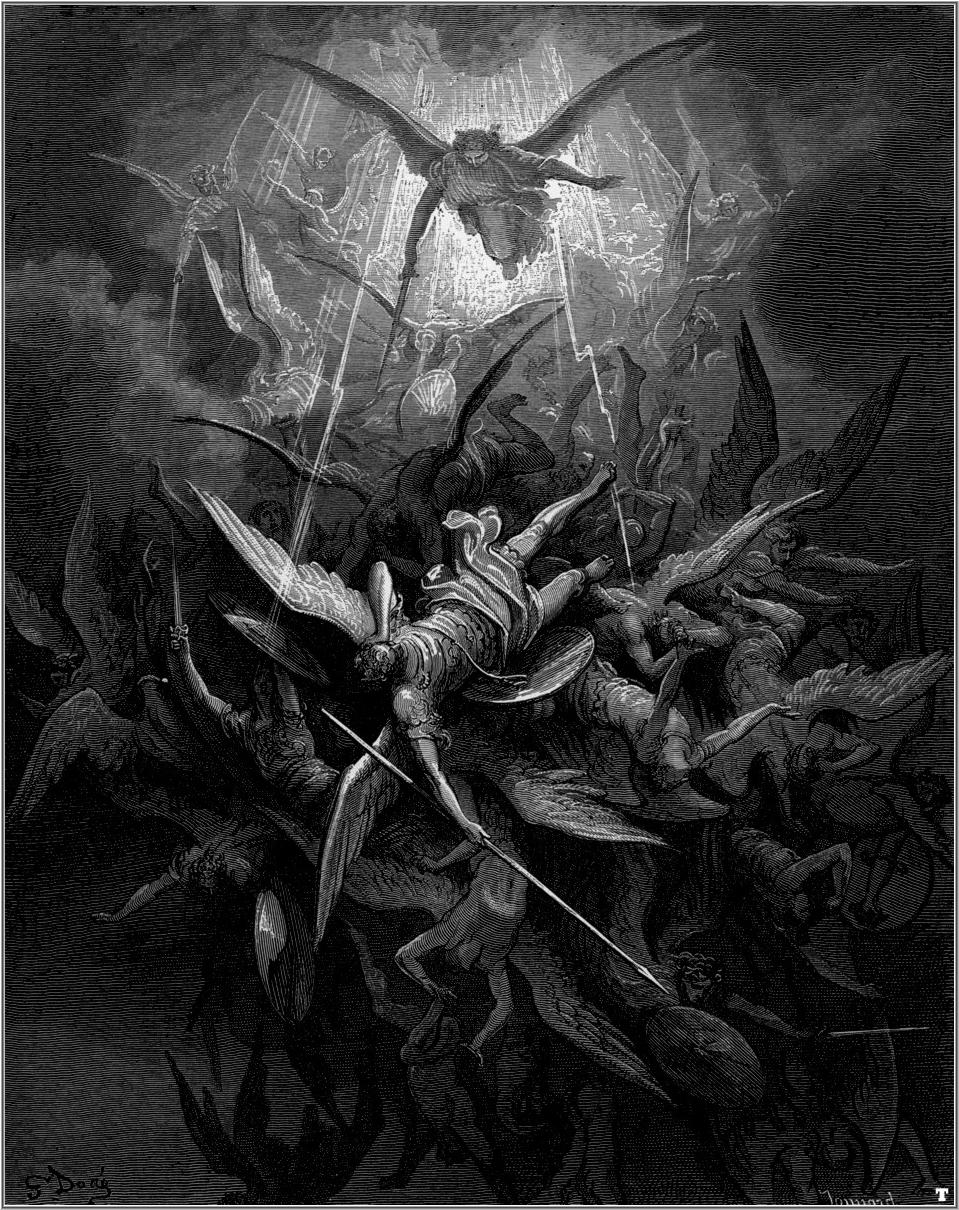
Illustration · Gustave Doré
Michael Casts Out the Rebel Angels — Paradise Lost, Book VI, lines 874–875. The archangel Michael leads the heavenly host in the war against Satan’s rebellion.
Section IV
Theological & Philosophical Epics
Mystical visions, spiritual autobiography, and the wellspring of the Western canon.
The Marriage of Heaven and Hell
William Blake
Mystical, mythic reimaginings of Christian cosmology with Romantic energy.
Samson Agonistes
John Milton
Shorter dramatic poem on heroism, suffering, and divine justice.
The Imitation of Christ
Thomas à Kempis
Devotional classic on spiritual formation and the interior life.
Confessions
Augustine
Foundational spiritual autobiography and soul-journey. The wellspring for the tradition.
The Bible (King James Version)
Job · Genesis · Revelation · Gospels
The wellspring for Milton, Bunyan, Dante, Blake, and the entire tradition. Essential reading in the KJV for its literary impact.
Section V
Broader Western Canon Companions
Works that share the same ambition, influence, and exploration of human and divine themes.
Oedipus Rex / Antigone
Sophocles
Tragic fate, moral order, and the limits of human knowledge.
Oresteia
Aeschylus
Justice, revenge, and divine resolution across three linked plays.
Theogony & Works and Days
Hesiod
Origins of the gods and the moral life. The earliest Greek poetry after Homer.
Beowulf / Sir Gawain and the Green Knight
Anonymous
Heroic and Christian moral tests from the Old and Middle English traditions.
The Waste Land / Four Quartets
T.S. Eliot
Modern echoes of Dante and spiritual pilgrimage. Dense, allusive, and essential.
Moby-Dick
Herman Melville
Epic quest with biblical and Faustian undertones. Ahab as tragic hero.
Guide
Tips for Reading
Start with Strong Translations
Mandelbaum or Hollander for Dante; modern annotated editions of Milton; Kaufmann for Goethe’s Faust. A good translation makes all the difference.
Use Guided Reading
Notes, audiobooks, and companions reward the density and allusions. The Paradise Lost Experience is designed for exactly this purpose.
Read in Order
Each work builds on what came before. Homer before Virgil, Virgil before Dante, Dante before Milton. Track the allusions as they accumulate.
Read Aloud
Epic poetry is meant to be heard. Milton’s blank verse, Homer’s dactylic hexameter, Dante’s terza rima—the rhythm transforms the experience.
Not Exhaustive
Harold Bloom’s The Western Canon expands further into hundreds of titles. Non-Western parallels exist (Mahabharata, Bhagavad Gita, Gilgamesh), but this list stays closest to the Judeo-Christian epic and allegorical tradition.