SwarmBound / Frostline expedition / 04 October 2026
Earn your place on the frontier.
A person, a rifle, and a damaged ship on a frozen mountaintop. Clear the perimeter, bring the outpost back to life, and train your way into a dangerous living world.
Godot · 3DSingle player firstSkill ranks + circlesDeliberate encounters
An MMO-style progression plan for an original science-fiction universe. The current slice supports Circles 1–3. Three two-node talent paths and bounded creature rolls are playable. Later circles and active secondary abilities remain proposed.
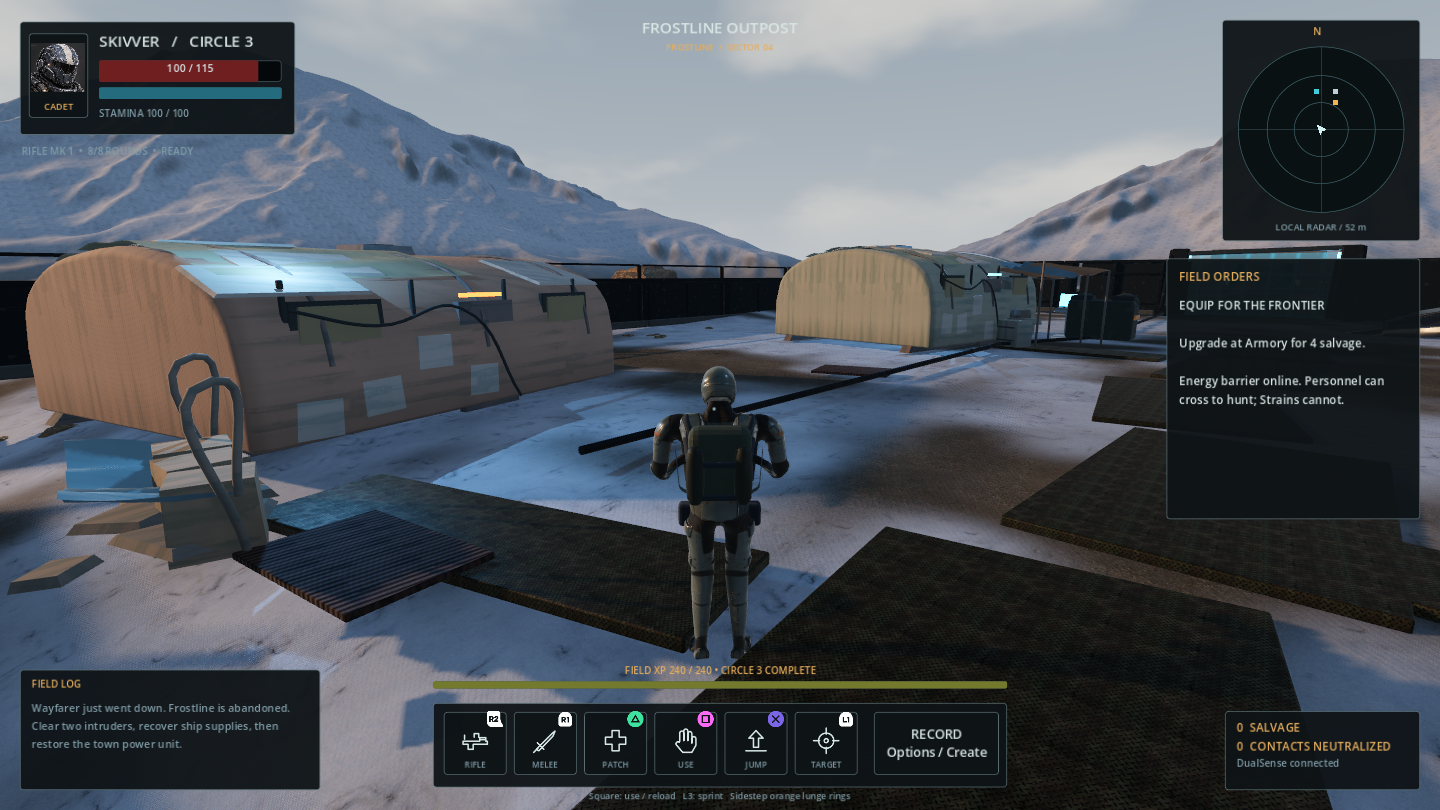
Actual current Godot build · fresh crash, abandoned mountaintop town, equipped ranger.
01 / The experience
A cautious expedition, one contact at a time.
Playable foundation
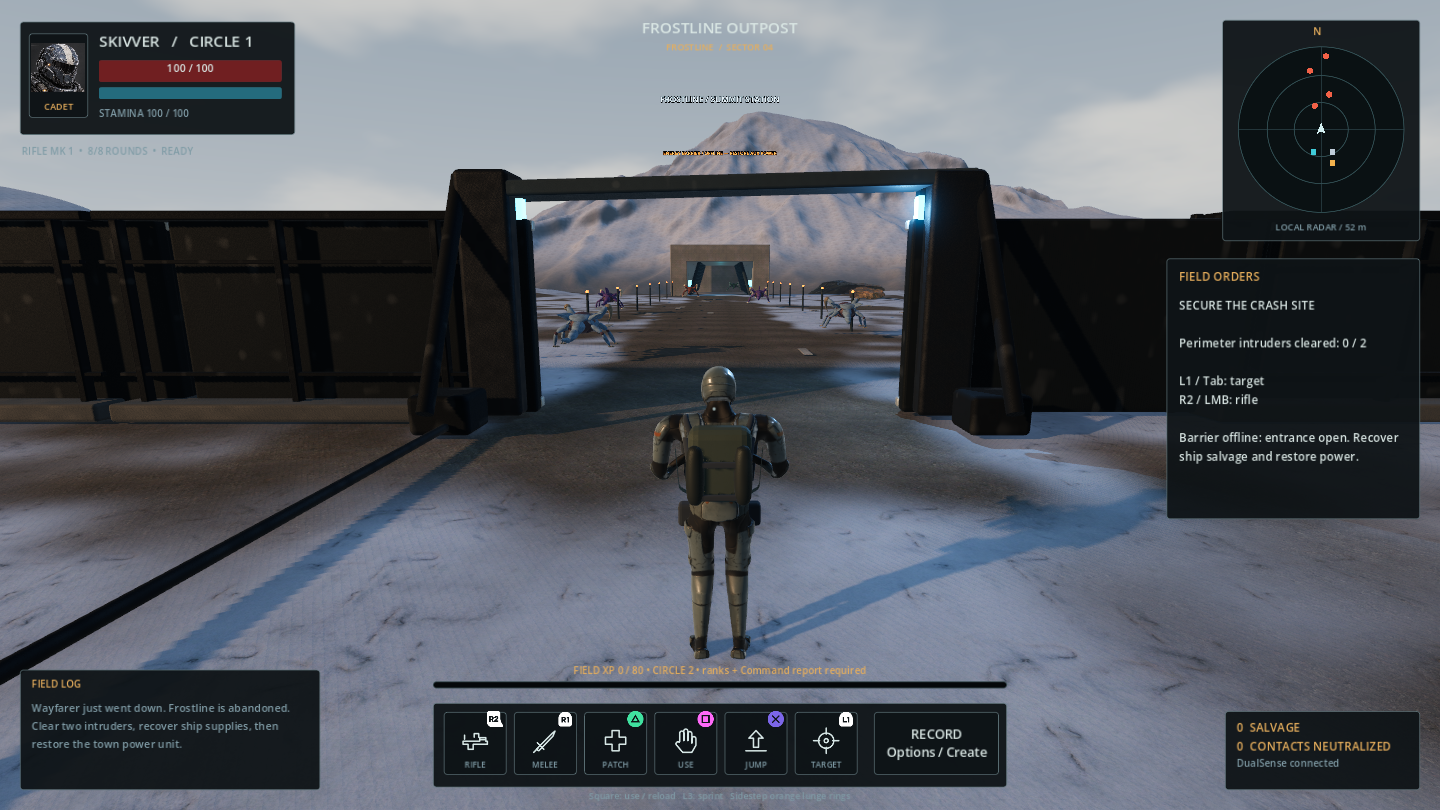
Secure the crash site
Two intruders are inside the border. Read their windups, dodge committed lunges, and recover salvage from the partly failed ship.
The mountaintop is your first territory: two buildings, a power station, a cargo breach, and a gated exit.
Prepare at the outpost
Restore power, recover health, and install rifle or armor upgrades. Choose attributes and talents when Command approves a new circle. The energy barrier starts offline and open; repairing power activates protection while letting personnel cross.
Recovery matters. Active threats and a six-second grace period block free healing at the boundary.
Hunt beyond the gate
Scout a creature, commit to a fight, then decide whether you can afford another. Return with salvage, field XP, and practiced skills.
Target a 28–45 second opening encounter, with stronger fights demanding more decisions. This is a playtest target, not a measured live-fight guarantee.
The tension: shooting costs stamina; moving reduces shot damage; sprinting stops fire. A reload is an opening for the creature. A second pull adds another lunge to read, rather than merely inflating the first creature’s health.
Ranger / Heavy human movement pass
Weight in the armor. A person underneath.
The movement pass adds knee compression, planted stance phases, hip and chest counter-motion, supported rifle grips, and smoother acceleration and turns. While targeting, the ranger sidesteps or backpedals while facing the contact; sprint turns into the direction of travel.
Implemented · 12 animation clips
Actual Godot gameplay model and movement controller · scripted input, with enemies held still for the movement demonstration. Jog → aimed sidestep → sprint. This is native game footage.
Run cycle · actual imported model in Godot’s asset studio, at the authored playback rate. In-game playback scales with movement speed.Aimed sidestep · wider stance, lifted recovery foot, torso stabilization and rifle support. Same model and clip used by the game.
This refines the existing rig and controller. It is still a prototype: foot placement is baked for flat ground; terrain-adaptive IK, motion-captured pivots, production skin deformation and polished additive action blending remain future work.
02 / Advancement
Experience opens the door. Practice earns the circle.
Field XP is cumulative and never spent on promotion. You also need the required skill ranks and mission milestones, then report to Command.
Circles 1–3 implemented
Current promotion requirements · all conditions must be met
Circle
Field XP total
Skill ranks
World requirement
Reward
1 · Stranded ranger
0
Begin at rank 0
Reach the crash site
Rifle, melee, field patch
2 · Perimeter scout
80
Rifles 2 · Defense 1 · Survival 1 · Engineering 1
Clear both intruders and restore power
3 attribute + 2 talent points
3 · Frontier operative
240
Rifles 4 · Defense 3 · Survival 3 · Engineering 2
Retain the secured outpost
3 more attribute + 2 more talent points
A concrete first promotion
Two intruders + one or two field Frostlings
24 + 24 + 29–37 = 77–85 field XP. A low roll needs a fourth encounter before promotion. Three all-rifle kills supply 54 weapon training XP, enough for Rifles 3; Circle 2 needs rank 2. Four resolved strikes can supply the 12 XP for Defense 1.
Three kills grant 24 Survival XP, enough for Survival 1. The first power repair grants 12 Engineering XP, exactly rank 1.
Weapon credit is shared with melee. Using both weapons splits the 18-XP budget. Evasions count toward Defense; taking damage is optional.
A concrete Circle 3 route
A hunting trip and equipment work
After reaching 80 XP, two Voltskitters, one Murkstrain, and one Frostling add 40 + 40 + 48 + 32 = 160, reaching 240 at baseline. Rolled totals can require another encounter.
Seven total all-rifle kills supply 126 training XP (Rifles 5). Seven kills supply 56 Survival XP (rank 3). Eighteen resolved strikes across those lives can supply 54 Defense XP (rank 3).
Engineering 2 requires 30 total XP: the repair (12), two wreck recoveries (10), and one upgrade (8) meet it exactly. These are possible routes, not kill-count-only promotion guarantees.
Promotion checker
Enter a hypothetical profile. This planner does not read or modify your game save.
Proposed expansion · not playable yet
Beyond the first three circles
Circle
XP
Ranks: weapon / defense / survival / eng.
4
550
6 / 4 / 4 / 3
5
1,000
8 / 6 / 6 / 4
6
1,800
10 / 8 / 8 / 5
Tentative gates: repair the ridge relay at C4, stabilize a second camp at C5, and clear the brood gate at C6. Allow Rifles or Melee as the primary weapon requirement in this expansion; the current code requires Rifles.
Keep three attribute points and two separate talent points per promotion, following the current C2/C3 budget. Tune these thresholds after observing completed expeditions.
At current normal rewards, the 550→1,000 step needs roughly 9 Emberclaw or 15 Frostling victories. Future zones need new enemy tiers and missions; simply repeating the opening camp is not the intended expansion.
03 / Learn by doing
Five skills. Different ways to train.
Current formulas
Skill
Training source
Effect now
Guardrail
Rifles
Effective damage / creature max HP × 18
+0.4 rifle damage per rank
18 XP shared with Melee per creature life
Melee
Same effective-damage formula
+0.4 melee damage per rank
Overkill, dry fire, dead targets award nothing
Defense
Up to 3 XP per resolved lunge, hit or evaded
+2.5 percentage points mitigation per rank
18 XP per creature life; total mitigation capped at 40%
Survival
8 XP per victory; 1 XP per 3 seconds moving in the frontier
Promotion requirements
Movement training remains available in the current slice
Engineering
First repair 12; wreck recovery 5; installed upgrade 8
Promotion requirements
Repeat station service gives no XP; wreck has 3 recoveries
Rank curve
Next rank costs 12 + 6 × current rank. Total training XP to reach rank n from zero is 3n² + 9n.
Total training XP84
Attributes are a different budget
Spend the three points from a promotion on persistent character stats. Talent points in the playable tree below are a separate currency.
Power: +1 damage per point to rifle and melee.
Vitality: +15 maximum health per point.
Endurance: +15 maximum stamina per point.
Proposal: replace unrestricted movement training with capped scouting objectives once exploration content exists, so running in circles is not the best advancement strategy.
04 / Build identity
Choose what your ranger becomes.
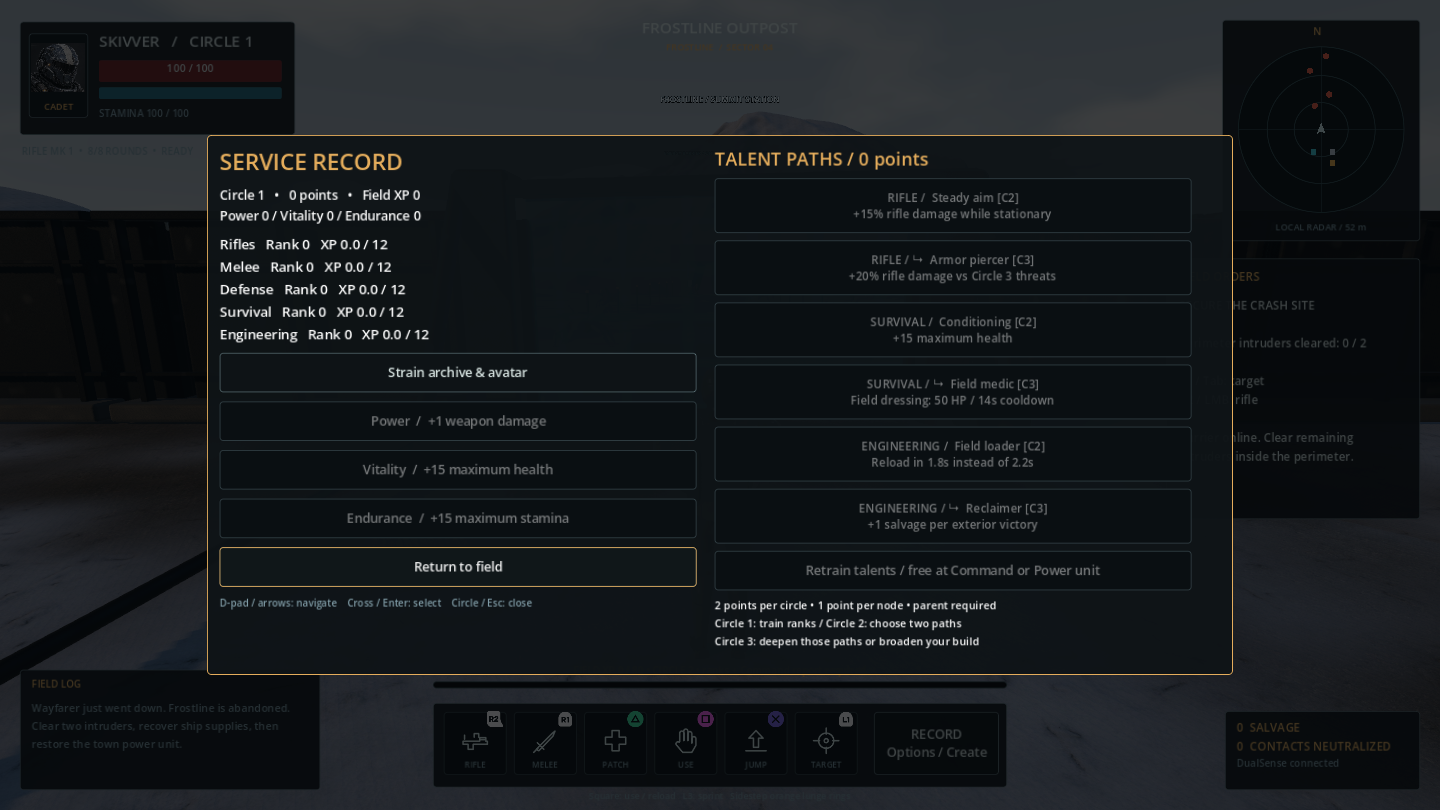
Ranks come from practice. Talents add new decisions. Each node costs one talent point and needs its circle and the preceding node in that branch. Two points arrive at each promotion; practice ranks remain promotion requirements.
Six talents implemented
0 / 4 spent
Click a node to inspect and select it. This planner mirrors the playable node costs and prerequisites. Use C / Options in the game to allocate your actual points.
Choose a node
Its ability, cost, cooldown, unlock requirements, and implemented game function appear here.
Circle 3 example: Steady aim → Armor piercer plus Conditioning → Field medic uses four points. Alternatively take all three starter nodes and one deeper node. Retrain free out of combat at Command or auxiliary power. This page plans choices; it does not modify your save.
WoW reference: Blizzard’s talent design preview informs meaningful choices and paths. This game retains its own skill ranks, circle requirements and encounter formulas.
An entrance you restore, rather than unlock.
The ship has just crashed. The settlement was already abandoned. Its energy barrier starts offline and open. Servicing auxiliary power activates protection: Strains and attacks are blocked, while your character can cross.
Implemented
Offline: open entrance, no barrier collision.Online: creature protection with personnel passage. Capture fixture shows power restored.
05 / Moment-to-moment actions
Make every button have a purpose.
Base actions implemented
Action
Keyboard / PlayStation
Cost & timing
Behavior
Rifle
Left mouse or 1 / R2
1 round, 4 stamina · 0.9 s cadence
32 m effective range; 8-round magazine; line of sight required
Melee
Q or 2 / R1
10 stamina · 1.5 s cooldown
2.8 m range; shared creature weapon-training budget
Reload
R / Square away from interactables
2.2 s
Holding fire starts reload when empty; reserve ammunition is unlimited in this slice
Field patch
F or 3 / Triangle
20 stamina · 18 s cooldown
Restore 35 health
Sprint
Shift / L3
16 stamina per second
6.4 m/s sprint vs 4 m/s jog; blocks firing. Aimed sidestep 2.4 m/s; backpedal 1.8 m/s.
Target / inspect ranks
Tab / L1 · C / touchpad
No resource cost
Cycle target / open progression. Backspace or Circle clears target.
Interact
E / Square
Context dependent
Power, wreck recovery, armory, Command
Rifle damage = 8 + Rifles rank × 0.4 + Power + rifle tier × 2. Melee damage = 13 + Melee rank × 0.4 + Power. Combat stamina recovers at 3/s; outside combat it recovers at 10/s.
Secondary attacks & action bar
Proposed interaction
Equip one weapon secondary, one defense action, and one utility action. Keep rifle fire, melee, reload, and field patch as dedicated base controls.
Proposed controller layer: D-pad Left / Right cycles the three equipped secondary slots; L2 activates the selected slot. L1 keeps cycling targets. Keyboard: 7 / 8 / 9. D-pad navigation remains available while menus are open. Display ammo, stamina cost, cooldown, and unavailable reason in the hotbar.
L2 is reserved for this proposal; controller mapping requires an in-game conflict and accessibility pass. Use target lock or an explicit aiming state, never a hidden target-selection rule.
The ability contract
Validate target, range, line of sight, equipment, cooldown, and stamina.
Reserve resources only when the action begins; recheck each scheduled burst shot.
Apply animation, hit timing, VFX, and sound from the same action event.
Resolve damage and interrupt rules once; grant skill credit through existing caps.
Expose remaining cooldown and failure reason to the HUD.
Today rifle/melee hits are immediate; enemy hits land after their windup. Planned animation-driven player hit events must preserve responsive input and measured fight pacing.
06 / Contact dossier
A strain is an identity. A roll is an individual.
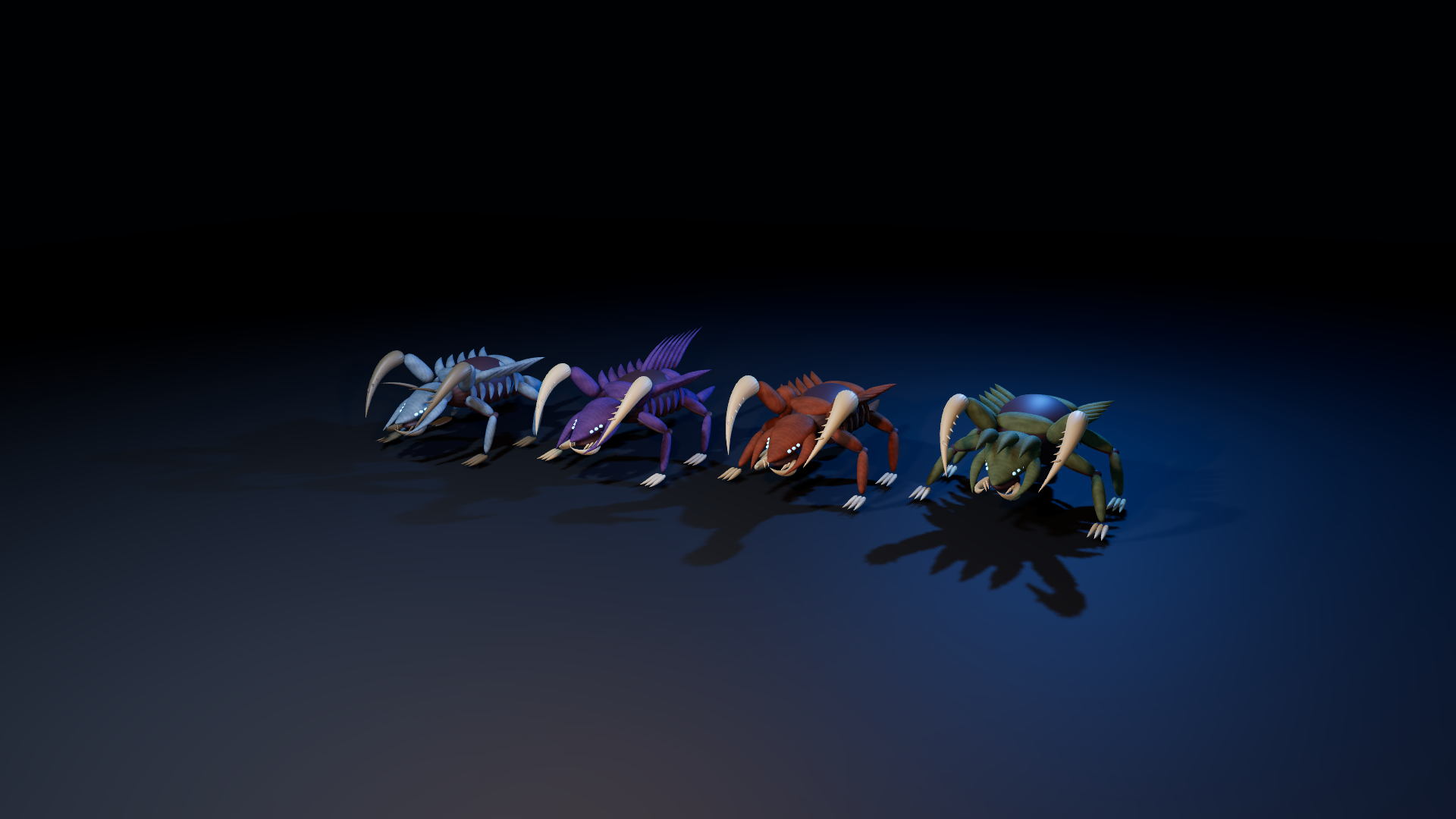
Keep the four recognizable creature silhouettes. Roll bounded stats and occasional readable traits within each strain, rather than turning every spawn into a different species.
Bounded rolls implemented
Actual authored strain models · Godot asset-studio render. Updated anatomy and nonmetal chitin; bounded stat rolls are playable. Affix mechanics remain proposed.Native Godot skeletal run clips · four imported creature models. Foot placement is authored for flat terrain.
Enemy baselines and live rolled rewards
Contact
Threat
HP
Strike
Speed m/s
Base XP
Live rolled XP*
Salvage
*Live rolls: health 90–115%, strike multiplied by sqrt(health roll), speed unchanged. XP = round(base XP × health roll); lighter creatures award less. The two tutorial intruders stay fixed at 24 XP each. Recommended threat circle is guidance, not an entry lock.
Live roll formula explorer
Roll a creature
Baseline manual scenario: fixed stats and no affix. Apply seed or New random spawn creates a reproducible rolled creature. The vigor slider creates a manual scenario.
Reward the actual challenge
HP = round(base HP × roll) Strike = base strike × sqrt(roll) XP = round(base XP × roll)
Roll ranges from 0.90 to 1.15. Speed stays fixed by strain. Frostling awards 29–37 XP, Voltskitter 36–46, Emberclaw 47–60, Murkstrain 43–55.
The HUD labels low rolls Lean, high rolls Hardened, and the middle Standard. These describe the stat roll, rather than a new affix attack.
Generate once per session spawn. Leashing and respawning retain the same stats; only a new session rerolls. Spawn state is not persisted yet. Defeat awards XP once; tutorial intruders stay fixed at 24 XP and never respawn.
Practice remains capped at 18 shared weapon XP and 18 Defense XP per life. Visible plated guards, volatile follow-up attacks and persistent spawn seeds are future content.
Encounter cadence estimator
Stationary, no incoming attacks, misses, or movement. Uses the rolled HP above, constant selected rank, immediate hits, and full magazine. Rolled stats follow the current game formula.
Measured current-game baseline
28.25 seconds
25 shots · 3 reloads
Measured in Godot against a stationary 200-HP Frostling with incoming attacks and movement disabled. Rank training remained active; this is a firing/reload benchmark.
The planner freezes rank for a transparent estimate. Formula: (shots − 1) × 0.9 + reloads × 2.2. Rank-ups during combat, movement, dodges, target access, and frame timing can change the live result.
Field contacts respawn after 45 seconds; cleared perimeter intruders do not. Leashed creatures recover full health, so repeated partial pulls cannot chip them down or refill their training budgets.
07 / Equipment & enhancements
Salvage should change what you carry.
Stat upgrades implemented
Current armory economy
Each installed upgrade costs 4 salvage and grants 8 Engineering XP.
Upgrade order alternates: rifle Mk II → armor Mk II → rifle Mk III → armor Mk III.
Each rifle tier adds 2 damage. Each armor tier adds 8 percentage points mitigation.
First power repair costs 2 salvage. Three wreck recoveries supply 2 salvage each, 30 seconds apart.
Defeat extracts you to the outpost and removes 2 salvage; no XP debt.
Today gear tiers change stats; new pieces do not yet visibly replace the player’s equipment. There is no full inventory or finite ammo reserve.
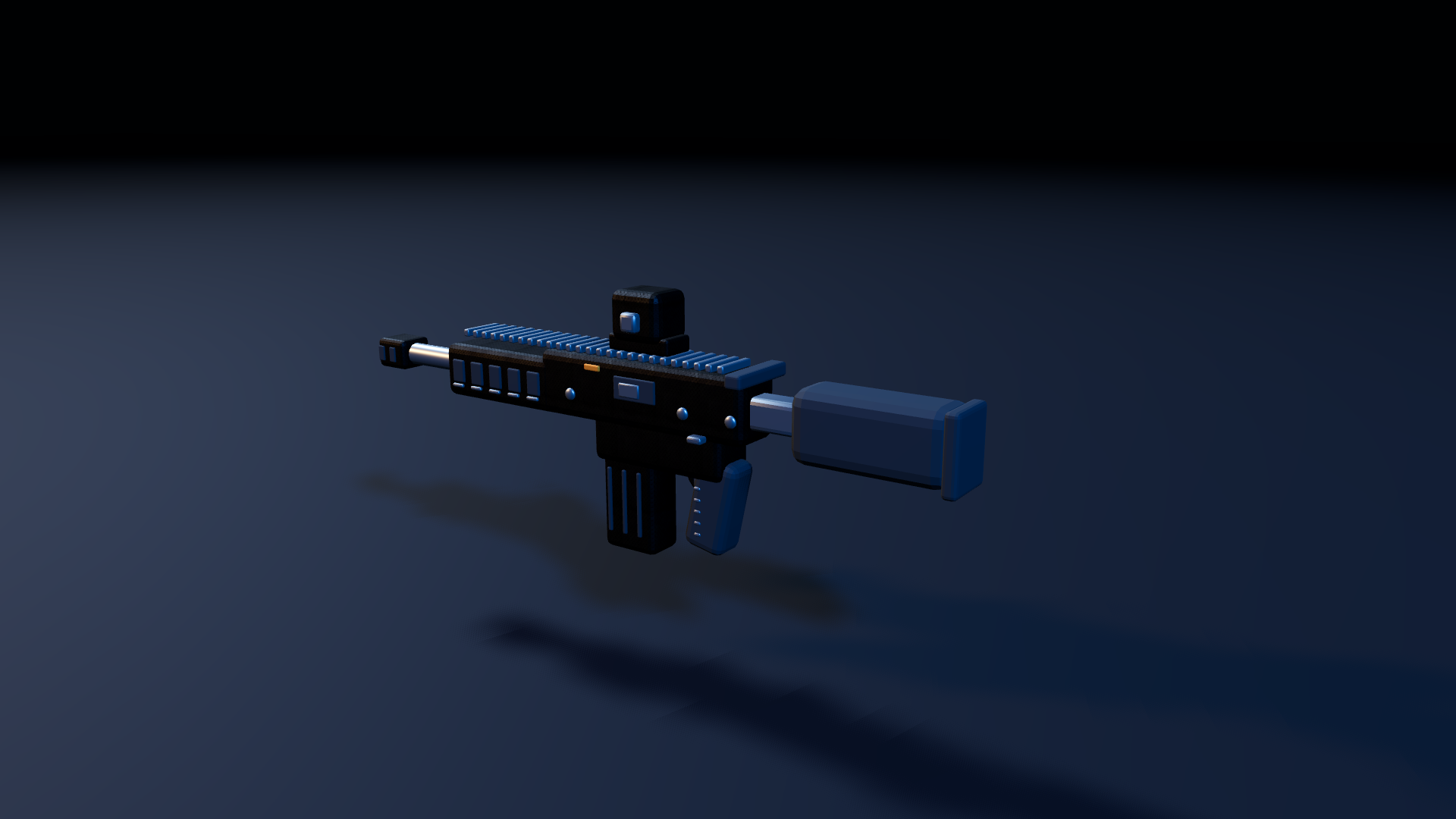
Current original rifle · bone attachment, muzzle flash, recoil, shell ejection, and impact debris are implemented.
Equipment proposal
Visible slots
Primary rifle, sidearm, torso armor, helmet, backpack, and utility module. Modules appear on the model, with clear Mk I / II / III silhouettes.
Start with rifle + torso + utility. Each item has one main stat and at most one perk; avoid unreadable random stat piles.
Enhancement proposal
Choose a tradeoff
A magwell enables Fast magazine. A stabilizer helps aimed fire but adds weight. A shield module enables Field shield at its talent gate.
Talents authorize abilities; installed modules supply hardware. Show missing hardware separately from missing skill or circle requirements.
Loot proposal
Bounded reward rolls
Keep base salvage guaranteed. Plated or Volatile contacts roll a 25% chance for +1 salvage and a future trait-specific crafting component.
Persist the loot roll with the creature seed and consume it once on defeat. No equipment drop rates until the item catalogue and upgrade costs are tested.
08 / Implementation order
Build the complete loop before widening the world.
Next development phases
Creature rolls + reward receipt
Bounded stats and proportional XP are playable. Next add persistent spawn state, trait visuals and once-per-life receipts across sessions. Keep the two intruders deterministic.
Acceptance: save/load recreates the same creature; leash cannot reroll; kill credit cannot duplicate; normal XP and tutorial totals match this guide.
A usable MMO action bar
Add target information, secondary slots, controller slot selection, cooldowns, costs, and failure reasons. Start with Disruptor shot and Quickstep.
Acceptance: keyboard and PlayStation can equip, activate, cancel, and inspect abilities without conflicting with base actions.
Talent points + visible equipment
Six talent nodes now persist separately from attributes. Next install physical modules and gear variants. Animate a detached magazine swap and terrain-aware foot placement.
Acceptance: no invalid prerequisites or negative point budgets; old saves receive the correct points; every gear change has a visible model result.
Expedition playtest + next zone
Track actual encounter time, incoming hits, evasions, resources spent, promotion bottlenecks, and controller errors. Then add the ridge relay and C4–6 missions.
Acceptance: new players can explain why promotion is blocked; pulls feel deliberate; retreat remains useful; each future circle introduces a new encounter or world function.
Multiplayer follows the single-player slice: keep combat, spawn rolls, inventory, progression, and reward receipts behind clear game functions now. Later, a server owns those decisions; clients send input and display outcomes. This page does not claim the prototype has networking.
Design numbers labeled “proposed” are planning values. No StarCraft game assets are used. The adapted human mesh derives from John Maksym / Moviemake’s sci-fi soldier, CC BY 3.0; modified mesh, rig, armor, equipment, animations, materials, and glTF export. Textures: Poly Haven CC0. Ship base: Quaternius CC0.